
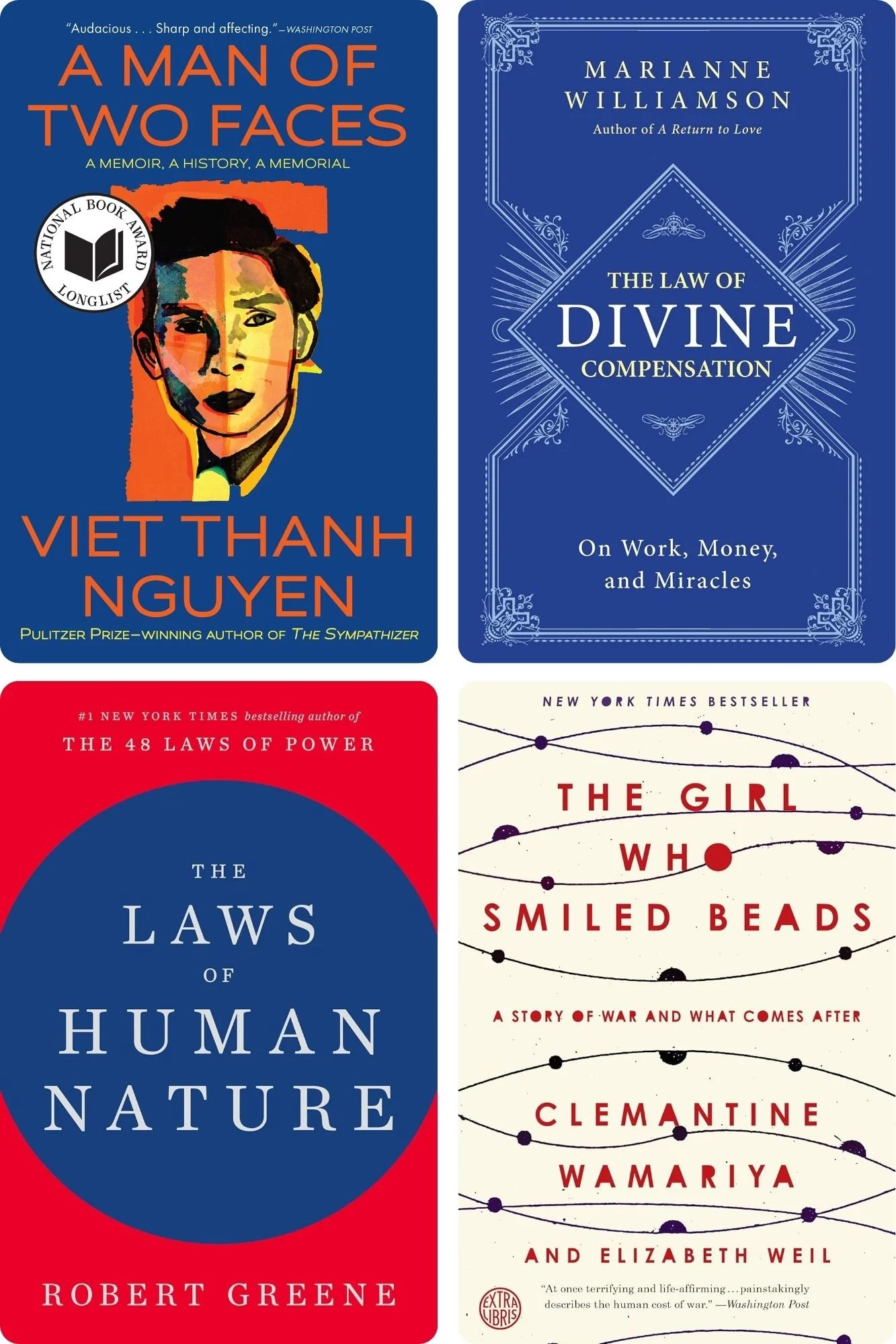
Books of 2025
2025 was the year of the wood Snake. One of intrigue and meaningful transformation. It was a time to look inward and work on ourselves. It was also one of immense challenge and difficulty, many things did not go according to plan but in between the hectic pace, there were moments filled with quiet where one was able to find some time to read. The pieces I was able to read weren't many but some interesting ones indeed. The books are as follows:
A Man of Two Faces by Viet Thanh Nguyen
This was written in 2023 the author explores his life as a Vietnamese refugee in America. Through an incisive analysis the main themes discussed are history, family, trauma, and the promises and betrayal of the American dream. The lenses in which the authors writes about his life include the refugee experience in which he details his family’s flight from Vietnam and his own separation from his parents as a child in which he experienced a foundational trauma.
Nguyen explores identity in other words the two faces and duality of his heritage and the cultural clashes that come with it. Another essential theme explored in the book is memory and forgetting, through trauma he examines the importance of both remembering and forgetting the past and how memory is distorted. And through this, it is very powerful.
Through the challenges and tribulations he experiences in his transition as refugee he writes about the American promise and offers critiques of the American dream. A fifth theme that plays throughout the memoir is form as Nguyen uses an unconventional approach that combines his personal story with historical and social critique that uses humour, lyricism and formal invention.
Last but not least A Man of Two Faces is centered around family as he takes a deeply personal look at his relationship with his parents, specifically with his mother linked with the legacy and displacement of war.
I give the book 5 out 5 and recommend this book for anyone who is a fan of memoirs.
The Divine Compensation: on Work, Money, and Miracles by Marianne Williamson - Written in 2012 Williamson offers a self help book that teaches spiritual principles for overcoming financial stress by aligning with faith and love to attract abundance. Williamson's thesis is that by shifting from a mindset of fear and what is lacking to one of faith and divine prosperity that individuals can unlock miraculous breakthroughs in their financial lives viewing wealth as spiritual right.
Key Themes and chapters include:
Overcoming financial stress and fear,
Making love the bottom line,
Transforming,
Negative self-perception,
Releasing, anger and guilt,
The difference between a job and a calling
Working miracles through purity of heart.
The main concepts of the book consist of Two realms, and distinguishes between the physical realm (stress, debt, fear), and the spiritual realm (divine promise of abundance). Williamson also writes about Faith as a muscle emphasizing that faith isn’t just hoping but an active mental and emotional practice to exercise. A third concept within the Divine Compensation is a mindset shift in which the author emphasizes a shift from what is lacking to believing in attracting miracles. Another concept lies within the title of Divine Compensation. Williamson writes that the universe is self organizing, and self-correcting, and it is important to align your mind with love to bring material manifestation.
Laws of Human Nature by Robert Greene - Published in 2022, Laws of Human nature is a self-help book that outlines 18 laws to help readers understand human behavior even their own to become more strategic and self aware. Greene uses historical examples and psychological insights to explain universal patterns like irrationality, narcissism, and envy, offering tactics of self control, empathy, and navigating social dynamics more effectively.
The Girl who Smiled Beads: A Story of War and What Comes After by Clemantine Wamariya and Elizabeth Wiel- Clementine Wamariya was six years old when her mother and her father began to speak in whispers, when neighbors began to disappear and when she heard the loud, ugly sounds her brother said were thunder. In 1994, she and her fifteen year old sister, Claire fled the Rwandan Massacre, and spent the next six years migrating through seven African countries, searching for safety- perpetually hungry, imprisoned and abused enduring and escaping refugee camps finding unexpected kindness, witnessing, inhuman cruelty. They did not know whether their parents were dead or alive.
When Clemantine was twelve, she and her sister were granted refugee status in the United States; she writes, “I’ve almost no photographs, no relics, or momentos to commemorate the gruesomeness and beauty of the days, months, years Claire and I spent trying to survive. When we arrived in the United States at O’Hare International Airport, we landed with nothing. The airline lost one suitcase. This had happened so many times. We’d lost everything. We’d been stripped down, repeatedly to the skin.” There in Chicago their lives diverged. Though their bond remained unbreakable, Claire who had for so long protected and provided for Clemantine, was a single mother struggling to make ends meet, While Clemantine was taken in by a family who raised her as her own. She seemed to live the American dream by attending private school, taken up cheerleading, and ultimately graduating from Yale. However, the years of being treated as less than human, of going hungry and seeing death, could not be erased.
In the Girl Who Smiled Beads, Clemantine challenges us to look beyond the label of “victim” and recognize the power of the imagination to move beyond the most profound injuries and aftershocks. Devastating yet beautiful and extremely original, it is a powerful testament to her commitment to living life on her own terms.
Supercommunicators: How to Unlock the Secret Language of Connection by Charles Duhigg- this book explores how to improve communication by recognizing three types of conversations 1) practical (what is it about?) 2) Emotional (how do we feel?) and 3) social (who are we?). Duhigg argues that effective communicators identify and match these layers using storytelling and research to show how to connect better in work and life, even in difficult situations. It serves as a guide to understanding the hidden dynamics of conversation to build deeper connections.


